Red Pandas' Class Summer Term
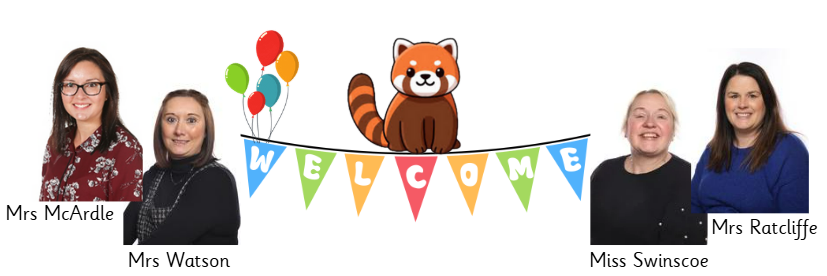
Mrs McArdle is the class teacher in Red Pandas on a Monday, Tuesday and Wednesday. She enjoys spending time with her family, being outside in the sunshine and reading. In the Spring Term, Mrs McArdle is looking forward to learning all about the Romans and about bees in our geography fieldwork unit.
Mrs Ratcliffe is the teacher in Red Pandas on Wednesday, Thursday and Friday. She enjoys sewing, reading, travelling and spending time with her family. Mrs Ratcliffe is really looking forward to creating some beautiful pointillism artwork in the Summer Term.
Mrs Watson is the Teaching Assistant in Red Pandas. Mrs Watson enjoys time with her family, and she loves art and drawing. She also likes listening to music and dancing. Also, she likes hugs! Mrs Swinscoe will also be spending time in Red Pandas. She is really looking forward to working in years 3/4. Outside of school, she enjoys spending time with her family, shopping and taking her dog Rascal for a walk. She is looking forward to all the new topics we will be learning. It is going to be a fun year!
Fridays will be very busy in Red Pandas as we will have our spelling tests, reading records checked and also homework will be due in. New homework and spellings will be given out every Friday. PE days in Red Pandas are Tuesdays and Thursdays.
History
In History, we will explore the fascinating civilisation of Ancient Egypt and discover what made it so successful and long‑lasting. We begin by learning how early Egypt developed along the River Nile. As they build their understanding of chronology, children 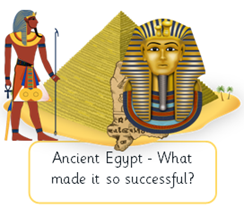 explore daily life, early writing such as hieroglyphics, and the powerful role of pharaohs and religion in shaping society. They then investigate how the Old Kingdom grew into a period of stability and impressive achievements, including pyramid building and strong beliefs in gods and the afterlife. As learning progresses, we will examine how Egypt changed over time, including the impact of invasions and periods of unrest, alongside the successes of the New Kingdom, when Egypt became a powerful empire with famous rulers such as Ramses II. By the end of the unit, children will understand how a combination of strengths and challenges led to the eventual decline of the Egyptian Empire, helping them to reflect on how civilisations grow, change and come to an end over time.
Geography
In our Geography learning, our children explore the fascinating world of bees through hands-on fieldwork, discovering why these small creatures play such a vital role in our environment and food supply. They learn about the challenges bees face today, including habitat loss, climate change and the use of pesticides, which are contributing to a decline in bee populations. Children then investigate how our school grounds can become a more bee‑friendly space, for example by creating  habitats rich in flowers and safe nesting areas. Through planning and carrying out their own conservation projects, pupils develop important scientific and teamwork skills, while learning how to carefully record their observations and evaluate the success of their efforts.
Writing
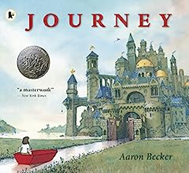 Our writing takes inspiration from two beautiful books – Journey by Aaron Becker
 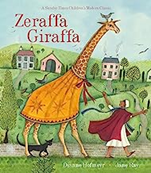 and Zeraffa Giraffa by Dianne Hofmeyr. Journey will provide us with the creativity for our first piece of writing – an adventure story using the language of Berlie Doherty. Our second piece will be a a persuasive guide for visiting Zeraffa at the Jardin des Plantes in Paris. Throughout our writing, we will continue to develop our grammar, punctuation and spelling through our Gateway, Mastery and Feature keys.
Reading
Our children will be reading a range of texts, including non-chronological reports entitled The Arctic Ocean and Infographic on Rocks, narratives called Jane's Jungle Journey and The Royal Escape, an explanation text about Mummies and a poem called The Centipede Song. In each unit, children will develop their reading skills and fluency through fun activities like echo reads, timed reads, and fluency grids. They’ll encounter lots of high-frequency and common exception words, helping them to read aloud and understand new vocabulary through practice. By discussing and connecting new words to what they already know, kids will boost their understanding. We’ll focus on retrieval skills so they can spot and explain important parts of different texts, whether it’s stories, facts, or poems. They’ll summarise main ideas, practise putting events in order, and learn how different bits of information relate to one another. Children will also make simple inferences about characters’ feelings and motives, using evidence from the text to support their thoughts. To boost their comprehension, we’ll use a range of vocabulary and inference questions throughout these engaging activities.
Maths
In the summer term, children explore fractions in greater detail, including finding and comparing fractions of amounts, before moving on to money, where they practise adding, subtracting and giving change in real-life contexts. They then develop their understanding of time, learning to read the time to the nearest minute and solve problems involving durations. Geometry is also introduced, with a focus on identifying and describing 2D and 3D shapes, as well as recognising angles. Finally, children begin to interpret and present data using bar charts and pictograms. Throughout the term, the emphasis is on reasoning, problem-solving and applying maths in practical situations, helping children to build confidence and fluency.
Computing
 In our Computing curriculum, children learn key programming skills through creating and adapting their own projects. They begin by understanding how sprites move in existing programs before developing their own, using simple commands to control movement in different directions. As their confidence grows, children learn to adapt programs for new purposes, add extra features, and identify and fix any bugs they encounter. This learning is brought together through the exciting challenge of designing and creating their own maze-based game. Alongside this, pupils explore creating media through stop-frame animation, learning that animation is created from a sequence of images. They plan, create, and review their own animations, developing patience, attention to detail, and creativity. By evaluating and improving their work, including the addition of sound or other media, children gain a deeper understanding of how digital content is created and refined.
Science
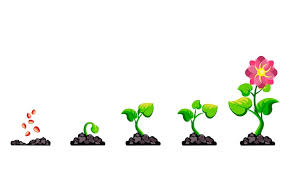 In Science, the children develop their understanding of flowering plants through hands-on exploration and questioning. They learn about the different parts of a plant, including leaves, roots, stems and flowers, and explore the important roles each part plays in helping plants grow and survive. Children investigate what happens when plants do not have enough space and begin to recognise how plants vary in appearance and structure. Building on this, they study the life cycle of flowering plants, discovering what is inside a flower and how pollination occurs, both with the help of animals and through the wind. The children also learn about how fruits are formed and the variety of ways seeds are dispersed. Through this learning, children develop scientific enquiry skills, curiosity about the natural world, and an understanding of how living things grow and reproduce.
Art
 Georges Seurat and the technique of pointillism, where tiny dots of colour are used to create images, are our Art inspiration. They explore how colours blend visually and experiment with creating shading and effects using dots. Children study Seurat’s work and other artists, before creating their own detailed pointillism artwork, building creativity and confidence.
PE
The children will develop their movement skills, coordination, and confidence through gymnastics and athletics. In gymnastics, children learn how to travel in different ways and link actions and rolls smoothly, before progressing to more challenging skills such as handstands, cartwheels, round-offs and jumps. They focus on control, balance, and technique while beginning to sequence movements into simple routines. In athletics, pupils concentrate on developing their jumping skills, improving both technique and performance through practice.
RE
In Religious Education, we explore the question of what we can learn from inspirational people in sacred texts and the history of religions. They study key figures and stories to understand the values these individuals demonstrated, such as kindness, courage and perseverance. Through discussion and reflection, children consider how these teachings can influence their own choices and behaviour, helping them to develop respect, empathy and an appreciation for different beliefs and traditions.
Design and Technology
In Design and Technology, the children will explore how castles are designed and built as strong structures. They learn about key features such as walls, towers, 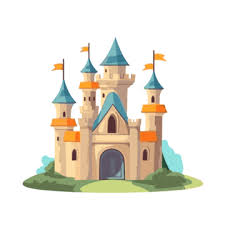 moats and drawbridges, and think about how these help with stability and defence. Children then design their own castle, using nets to help plan and create structures. By the end of the unit, pupils build their own model castle, developing skills in designing, making and evaluating their creations.
Music
In Music, pupils explore the Charanga units Enjoying Improvisation and Opening Night, developing their confidence and creativity. They learn to listen to different styles of music, create their own ideas through improvisation, and rehearse simple performances. Children build skills in singing, playing, and working together, gaining enjoyment and confidence as young musicians.

French
The children will be developing their speaking, listening and reading skills in French. They learn to name common foods, express likes and dislikes, and build simple sentences with growing confidence. Through songs, games and conversation, children practise pronunciation and begin to understand basic grammar, fostering enjoyment and confidence in learning a new language.